
You pick up a snack, flip it over and read the ingredients list. Gelatin. Mono and diglycerides. Natural flavour. Is that halal or haram? If you have ever asked that question, you are not alone.
We wrote this guide to make the topic simple. Below, we explain what halal and haram mean, share a clear list of halal and haram food, and show you how to read food labels with confidence. Whether you follow a halal diet or just want to understand it better, this is for you.
Understanding Halal and Haram: The Basics
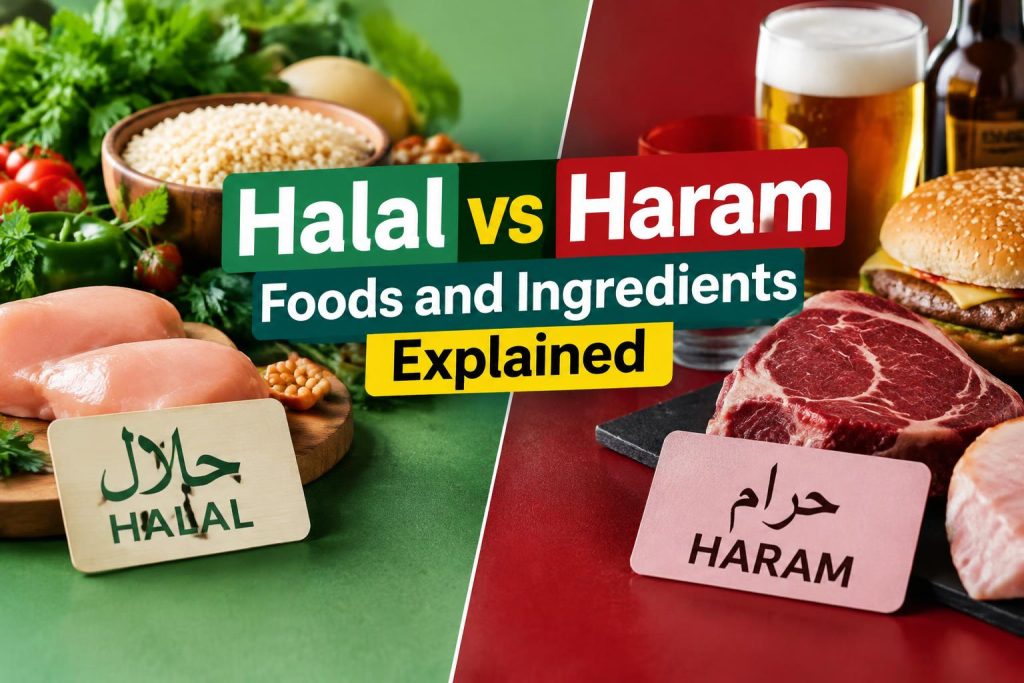
Halal is an Arabic word that means “permissible” or “lawful.” Haram is the opposite. It means “forbidden.” Together, they form the basis of Islamic dietary laws, which come from the Quran and the teachings of the Prophet Muhammad.
Halal means more than “no pork.” It covers where food comes from, how an animal is slaughtered, what goes into a food product, and how food is prepared. Halal isn’t a trend or a marketing label. It is a religious guideline that shapes daily life for millions of Muslims.
The General Rule: Food Is Halal Unless It Is Haram
Here is the simple rule most scholars follow: food is halal unless the Quran or the Prophet’s teachings clearly prohibit it. That means most plant foods and many animal foods are permissible by default.
A food becomes haram in a few ways:
- It comes from a prohibited source, such as a pig.
- It is made through a prohibited method, such as improper slaughter.
- It contains a prohibited substance, such as alcohol or blood.
- It has touched haram material, which we call cross-contact.
Keep these four ideas in mind. They explain almost every halal or haram decision you will face.
Common Halal Foods
Many everyday foods are halal. Common halal foods include:
- Fruits and vegetables: Fresh, frozen and dried produce is halal.
- Grains: Rice, wheat, oats, corn and bread are halal.
- Dairy: Milk, yogurt and butter are halal. Cheese needs a closer look (more on rennet below).
- Eggs: Eggs from halal animals are halal.
- Fish and seafood: Most scholars consider fish halal. Views on other sea animals differ between schools of thought.
- Halal meat: Chicken, lamb, beef and goat are halal when slaughtered correctly.
- Nuts, seeds, legumes and oils: All are halal in their natural state.
Halal food also includes the dishes you make from them, as long as you cook and store them away from haram items.
Common Haram Foods and Substances
Now to the other side of the list. Common haram foods and haram substances include:
- Pork and its by-products: This includes bacon, ham, lard, and pork gelatin.
- Alcohol and intoxicants: Wine, beer, spirits, and any food made with them.
- Blood and blood products: These are prohibited in Islamic law.
- Animals that died on their own: Meat from an animal that was not slaughtered is haram.
- Meat not slaughtered according to Islamic rules: Even a halal animal becomes non-halal if the method is wrong.
- Carnivorous animals and birds of prey: Most scholars consider these haram.
Some foods are also considered haram because of how they are made or what they touch. A halal chicken cooked on a grill shared with pork, for example, may no longer meet halal requirements.
Halal Meat and the Method of Slaughter
Meat is where the rules get the most detailed. For meat to be halal, the animal must be a permitted type, and it must be slaughtered according to Islamic law. The main requirements are:
- The animal must be alive and healthy at the time of slaughter.
- A Muslim must perform the slaughter and say the name of Allah.
- A sharp knife makes a swift cut across the throat to sever the windpipe and main blood vessels.
- The blood must drain fully from the animal.
- The animal must be treated with care before slaughter.
This halal slaughter process is why halal meat has its own supply chain, from farm to shop. Some details, such as stunning before slaughter, differ between halal certifiers. That is one reason why checking the source matters.
Halal vs Haram Ingredients: The Hidden Ones
The hardest part of eating halal is not the obvious foods. It is the ingredients that hide in processed food. Modern food processing uses hundreds of additives, and many of them come from animal sources. Here are the ones we see most often.
| Ingredient | Halal status | What to check |
|---|---|---|
| Gelatin | Often haram | Usually from pork or non-halal beef. Fish gelatin or halal-certified gelatin is fine. |
| Rennet | Depends | Animal rennet may come from animals not slaughtered in a halal way. Microbial rennet is usually fine. |
| Alcohol and extracts | Often haram | Vanilla extract and some flavours use alcohol. Scholars differ on trace amounts. |
| Mono- and diglycerides (E471) | Might be haram | Can come from animal or plant fat. Check the source. |
| L-cysteine (E920) | Might be haram | Sometimes derived from animal hair or feathers. |
| Lard and animal shortening | Haram if pork | Check the type of fat on the label. |
| Natural flavours | Unclear | Can hide animal or alcohol-based ingredients. |
| Carmine (E120) | Debated | Comes from insects. Scholars differ on its status. |
Notice how many items say “depends” or “might be haram.” That is real life. A single ingredient can be halal or non-halal based on its source, and the label often will not say which.
How to Read Food Labels
Reading food labels takes practice, but it gets easier. Here is what we suggest:
- Start with the ingredients list. Scan for gelatin, lard, alcohol, rennet, and animal-based additives.
- Look at food additives. Check E-numbers that may come from animal sources.
- Check for allergen notes. They sometimes mention pork or other animal products.
- Look for a halal logo or halal symbol. A recognized logo is the fastest sign that a product has been checked.
- Contact the maker if unsure. Many companies will tell you where an ingredient comes from.
When a label says “natural flavour” or “enzymes” with no source, you cannot tell if the product is halal. In that case, you can choose a certified alternative or contact the brand.
What Is Halal Certification?
Halal certification is a process in which an independent body checks that a food product, plant, or restaurant follows halal guidelines. A halal certifier reviews ingredients, suppliers, slaughter methods, equipment, and cleaning steps. If everything meets the standards, the company can display the certifier’s halal logo.
A few points to keep in mind:
- Certifiers differ. Standards can vary by country and by organization, so many Muslims pick recognized halal certification bodies they trust.
- A logo is not always proof. Anyone can print the word “halal” on a package, but only a certified halal product has been audited.
- Compliance is ongoing. Good certifiers re-check companies on a regular basis.
Halal certification gives consumers a way to trust what they cannot see, such as a factory in another country. It also helps businesses reach the fast-growing halal market, which serves Muslim and non-Muslim shoppers who want clear sourcing.
Halal Food in Daily Life: Eating Out
Eating at home is the easy part. Eating out takes more care. Even if a restaurant serves a halal menu, you may want to ask a few things:
- Where does the meat come from, and who certifies it?
- Do you cook halal and non-halal food on the same grill or fryer?
- Do your sauces and desserts contain alcohol or gelatin?
A good halal restaurant answers these questions without fuss. If you are in Dallas, Blaze Halal Burger Co. is one place to try. The menu covers burgers, crispy chicken, wings, gyros, salads, and baklava, and the restaurant says it focuses on halal food.
Common Mistakes About Halal and Haram
“Vegetarian food is always halal.” Not always. A vegetarian dish may include wine, alcohol-based extracts, or animal rennet.
“If it says halal, it is certified.” Not necessarily. Always look for a recognized halal certification when it matters to you.
“Halal is only about meat.” Meat is a big part, but ingredients, preparation, and cross-contact count too.
“Halal is only for Muslims.” Anyone can eat halal food. Many non-Muslims choose it for its standards and clear sourcing.
Tips for Following a Halal Diet
If you want to follow a halal diet, a few habits make life easier:
- Buy meat from a halal shop or a trusted halal-certified brand.
- Learn the common haram ingredients so you can spot them fast.
- Keep separate utensils and cookware if you share a kitchen.
- Choose certified products when you buy sweets, snacks, and ready meals.
- Ask questions. Restaurants and brands expect them.
You do not have to memorize every E-number. Start with the list above and add to it as you learn.
Frequently Asked Questions
What is the difference between halal and haram?
Halal means permitted under Islamic law. Haram means forbidden. Pork, alcohol, and blood are common haram items.
Is gelatin halal or haram?
It depends on the source. Gelatin from pork is haram. Gelatin from fish or from halal-slaughtered animals is generally accepted.
Is cheese halal?
It can be. Cheese made with microbial or plant-based rennet is usually halal. Cheese made with animal rennet from non-halal sources is not.
Can I trust a halal logo?
A logo from a recognized halal certifier is a strong sign. Be careful with unknown logos or plain “halal” text with no certifier named.
Is seafood halal?
Most scholars say yes for fish. Views on shellfish and other sea animals vary between schools of thought.
Do non-Muslims eat halal food?
Yes. Halal food is open to everyone.
Final Thoughts
Halal and haram might feel complicated at first, but the idea is simple. Food must come from a permitted source, be prepared in a permitted way, and stay free of prohibited substances. Once you know the main rules and the hidden ingredients to watch for, reading food labels gets much easier.
We hope this guide gives you a clear list of halal and haram foods and the confidence to make your own choices at the shop, at home and at the table.